


Table of Contents
Let’s be real for a second.
We’ve all been there. You’re at a party where you hardly know anyone. You’re standing in the corner, holding a lukewarm drink, feeling a bit awkward. Then, someone next to you leans in and whispers, “Is it just me, or is this music absolutely terrible?”
Instantly, the tension melts. You let out a laugh. “Oh my gosh, I was just thinking that. It’s like a chaotic elevator soundtrack.”
Boom. Connection formed.
For years, we’ve been told that friendships are built on shared passions—loving the same sports team, enjoying the same hiking trails, or obsessing over the same authors. And sure, that’s true. But there is a darker, cheekier, and scientifically proven shortcut to friendship that we don’t talk about enough: Negative Social Bonding.
Or, as I like to call it, the art of bonding over what we can’t stand.
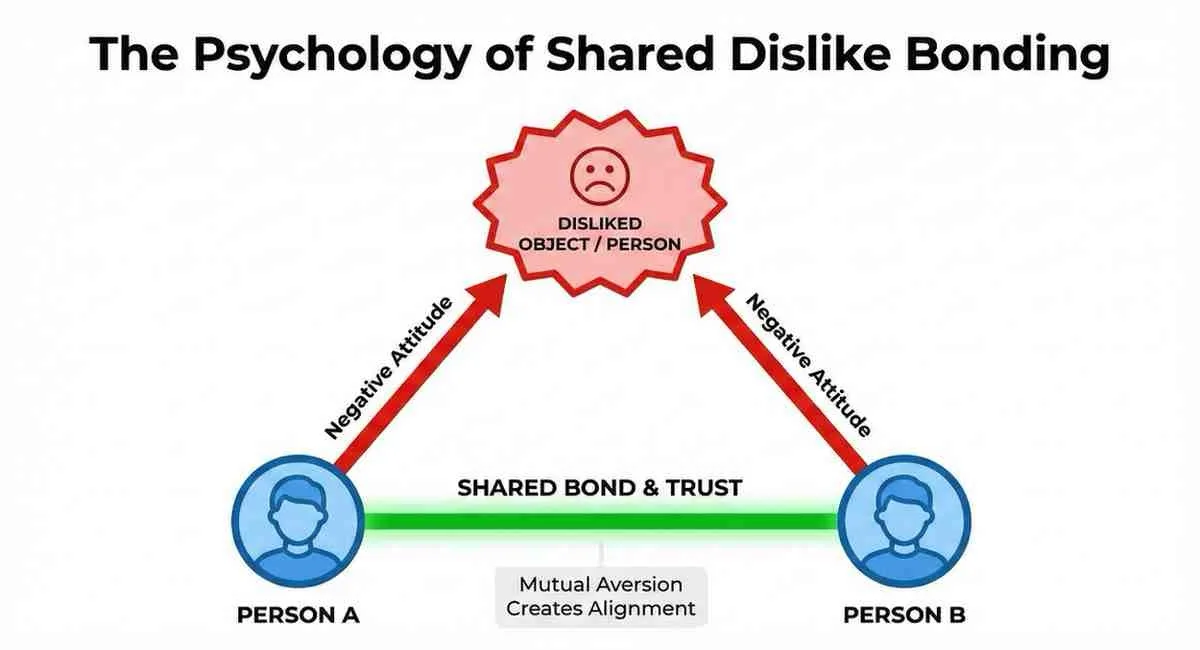
The Science Behind the Snark
This isn’t just an anecdotal observation; it’s a documented psychological phenomenon.
The heavy lifting on this topic comes from a fascinating study by Jennifer Bosson and her colleagues at the University of South Florida. In their research (specifically a 2006 study titled “Interpersonal Chemistry Through Negativity”), they discovered something that feels slightly illegal to admit.
Shared dislikes promote closeness more effectively than shared likes.
In their experiments, Bosson found that when two strangers discovered they both disliked the same third party (a fictitious person named “Brad” in one experiment), they felt significantly closer to each other than strangers who discovered they both liked the same person.
Why Does Hating the Same Thing Feel So Good?
Why does complaining about a strict boss or a soggy pizza create a stronger instant bond than praising a great movie? Psychologists point to a few key reasons:
1. It’s a Trust Signal
Expressing a dislike is risky. If I say, “I love puppies,” that’s a safe, socially acceptable statement. Everyone loves puppies. But if I say, “I actually can’t stand that popular new TV show,” I am making myself vulnerable. I’m revealing a non-conformist opinion. When you agree with me, you validate that risk. It creates an immediate “us vs. them” bubble of trust.
2. It’s “High-Diagnostic” Information
In psychology, negative attitudes are considered “more diagnostic” of a person’s true character than positive ones. Knowing you like ice cream tells me almost nothing about you. Knowing you hate ice cream? That’s rare. That’s specific. It makes me feel like I know the real you faster.
3. We Seek Balance
This goes back to Heider’s Balance Theory. If I dislike X, and you dislike X, our relationship is “balanced” mathematically (a negative times a negative equals a positive). We are aligned against a common “threat,” even if that threat is just a pineapple on a pizza.
The Trap: Don’t Build a House on a Landfill
Now, before you go out and base your entire social life on trash-talking, there is a catch. A big one.
While shared dislikes are an incredible catalyst for starting a friendship, they are a terrible foundation for sustaining one.
This is where we run into a concept called Co-rumination. This is when friends excessively discuss personal problems or negative feelings. While it creates closeness, studies show it can also lead to increased anxiety and depression.
If your friendship is 90% complaining about other people, you aren’t just bonding; you’re emotionally draining each other. The “high” of the shared dislike wears off, and if there are no shared positive values—like kindness, similar life goals, or actual hobbies—the relationship often turns toxic or fizzles out when the “enemy” disappears.
The Verdict?
Use the shortcut, but take the scenic route.
It is perfectly okay to bond with a new work buddy over how confusing the new coffee machine is. Lean into that. It’s human. It’s authentic. It’s “Negative Social Bonding” doing its evolutionary job to help you find your tribe.
But for that work buddy to become a life buddy, you eventually have to pivot. Once the complaints have broken the ice, make sure you have something solid to stand on.
So, I’m curious—what was the “common enemy” that started your best friendship? Was it a terrible professor? A mutual hatred of cilantro? Let me know in the comments below!


